Tunneling is when a candle burns straight down the middle, leaving a ring of unmelted wax around the edges. It often happens because the first burn was blown out before the melted wax reached the edges of the vessel.
As a chandler (candle-maker) I've been asked about this many times, and here's the thing I want you to know upfront: it's usually preventable, and it's usually fixable. But it isn't always your fault. There's real wick science and chemistry behind why candles burn the way they do, and I'd rather walk you through all of it than just tell you to "burn it longer."

Why Tunneling Happens: Wax Has Memory
Whatever size the melted wax pool reaches on the very first burn tends to become the pattern the candle follows for its entire life. If you blow it out after only 20-40 minutes, before the wax has melted edge to edge, the candle "remembers" that smaller circle. On future burns, the flame often can't generate enough heat to break past that ring, and the wick can even smother itself, since it's burning too close to unmelted wax and not getting enough oxygen.
How to Prevent It
- Trim the wick to 1/4 inch before every single burn, not just the first one. We'd recommend using a wick trimmer instead of scissors, since a trimmer catches the trimmed piece rather than dropping it into the wax. Nobody wants a pile of trimmed wick sitting in their candle.
- On the first burn, let the wax pool reach the edges of the glass. For most candles, that takes about 1-2 hours.
- Burn for 4-5 hours at a time, maximum. Your wick needs rest. Burning longer than that doesn't help the candle, it just adds unnecessary heat and risk to the vessel, makes the flame too high, and increases the amount of soot emitted.
What a Healthy Burn Looks Like

Example of an appropriate size mushroom after burning a candle for 3-4 hours with a full wax melt pool.
After a longer burn, a small amount of "mushrooming" on the wick tip is completely normal. If the mushrooming is excessive, or the flame looks unusually large, that's a sign the candle has been burning too long or too hot during that time. A large flame isn't just inefficient, it's a real fire risk, both from the flame size itself and from the vessel overheating, especially as the candle nears the end of its life. This is exactly why candle warning labels tell you to discontinue use once about 1/4 inch of wax remains.

Example of an oversized mushroom after burning a candle for 3–4 hours and allowing the wax to solidify.
Choose a Fire-Safe Surface
Always burn candles on a fire-resistant surface, stone, a solid countertop, a stone coaster or FRT lumber. Avoid wood, plastic laminate, or anything that could be damaged or ignited if the vessel gets hot.
When Tunneling Isn't User Error: The Wick Science
Here's what most candle brands leave out. Sometimes tunneling has nothing to do with how you burned the candle.
Wick size and quantity are determined by three things: the diameter of the candle, the type of wax it's poured in, and the fragrance throw the maker is aiming for. There are literally hundreds of wick options on the market, starting with the basic split between cotton and wood wicks. Within cotton wicks alone, different ratios of cotton to paper change how the candle burns, how strong the hot throw is, and how much soot it produces. Soy wax and paraffin wax also respond differently to the same wick. If a maker chooses the wrong wick for a given wax, vessel size, or fragrance, the candle can struggle to burn evenly no matter what you do.
Fragrance Overload Can Also Cause Uneven Burning

There's another cause worth knowing: too much fragrance oil can actually clog the wick. Every wax has a fragrance load, the amount of fragrance oil that both the fragrance manufacturer and the wax manufacturer recommend for that specific wax. It's a common myth that more fragrance oil means a stronger-smelling candle. In reality, going past the recommended fragrance load throws off the chemistry of the wax, and fragrance oil can actually leak or seep out of the wax itself rather than burning cleanly. If you've ever opened a candle and seen wet spots sitting on top of the wax, that's often exactly what's happening, it's literally fragrance oil seeping out of the candle.
This is also why marketing terms like "double scented" or "triple scented" don't hold up to scrutiny. Every wax has a fragrance load ceiling. With 100% soy wax specifically, the recommended fragrance range most often does not allow for anything close to double or triple the standard amount, so those claims are more about marketing language.
How to Fix a Tunneling Candle: The Foil Teepee Trick

If tunneling is happening because of a short first burn, it's usually fixable.
- Light the candle as normal.
- Cover it with a small teepee of aluminum foil, leaving a hole at the top center for oxygen, similar to how you'd tent foil over food.
- Let it burn like this for no more than 1 hour at a time, staying in the room the whole time to monitor your candle.
The foil slightly raises the heat at the surface, helping the wax finally break past that ring and reach the edges. Only do this with candles poured in sturdy, professional-grade vessels, never anything thin, fragile, or vintage, and always keep an eye on it while it's burning. There is always the risk of the vessel overheating which can lead to cracking and risk of harm and/or fire.

Why Even Good Candles Sometimes Have Burn Issues
If you've done everything right and still run into problems, it's not always about you. Sometimes it comes down to rushed research and development, a lack of care in properly testing a candle before it goes to market. Different vessels, waxes, and fragrances interact differently with different wicks, and if that combination isn't properly tested before a candle goes to market, burn issues can slip through. This is part of why you'll sometimes find well-known, luxury-name candles showing up in off-price stores, either a performance issue got caught late, or the brand needed to move perfectly good stock. That's simply a risk worth knowing about before you shop off-price, not a guarantee something's wrong. In other cases, candles made specifically for off-price retail are built to a lower-margin spec from the start, with corners cut somewhere to hit that price point.
As a rule, we never sell our R&D samples. Anything you find at our warehouse sales or marked down is never a candle compromised on performance. It simply means we made too many, it's a discontinued design, or there's some slight cosmetic damage that doesn't affect how the candle burns.
Why Scripted Fragrance Is Different

We're proud to balance genuine burn and throw performance with a beautiful candle at a price point that still feels fair. Every candle is hand-poured at our historic Manor House, and that care and integrity is exactly why we stand behind what we make. When you shop with us, you can trust the candle in front of you was made to actually perform, not just look good on a shelf.
No matter how much you paid for a candle, it still needs a little bit of care from you. Price doesn't buy you the ability to walk away and ignore it, even a well-loved toddler still needs someone watching. A candle deserves that same bit of attention, no matter what you paid for it.
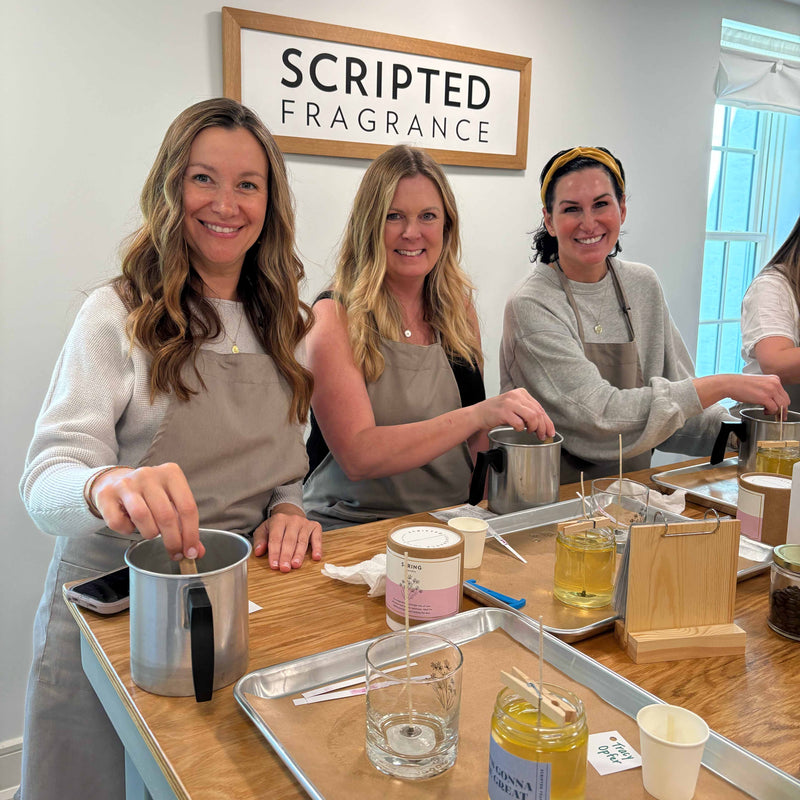
If you'd like to learn all of this hands-on, consider joining us for a candle-making class at our Warwick studio, where we walk you through wicking, pouring, and everything in between in person. You can read more about what the experience is like on our blog.
FAQ
What causes a candle to tunnel?
Tunneling happens when the first burn is cut short before the wax pool reaches the edges of the container. The candle "remembers" that smaller melt pool and tends to repeat it on future burns. It can also happen when a candle isn't wicked properly, meaning the wick size, placement, or quantity doesn't match that particular candle.
How long should the first burn last?
Let the first burn go until the wax has melted edge to edge, generally 1-2 hours, rather than blowing it out after 20-30 minutes. From there, you can keep burning for an additional 2-3 hours if you'd like, for a total of no more than 4-5 hours at a time.
How often should I trim the wick?
Trim the wick to about 1/4 inch before every burn, not just the first one.
How long can I safely burn a candle at once?
3-4 hours is recommended, 4-5 hours per burn should really be the max. Longer burns add unnecessary heat and fire risk without benefiting the candle.
Can too much fragrance oil cause burn problems?
Yes. Every wax has a maximum fragrance load. Exceeding it can clog the wick and cause fragrance oil to leak from the wax rather than burn cleanly, which is also why claims like "triple scented" don't hold up mathematically for most waxes.
Can a tunneling candle be fixed?
Often, yes, using the foil teepee method: tent foil over the lit candle with a small opening at the top, burn for no more than an hour at a time, and stay in the room while it burns.
Can I pour my candle wax on my skin?
No. Our candles are formulated with fragrance loads recommended for candles meant to be inhaled, not for skin contact. Products intended to touch skin, like massage candles, require a different, typically much lighter fragrance load under IFRA guidelines. If a massage candle has a strong fragrance while burning, that's worth questioning, it may signal the fragrance load and safety standards for skin-contact products aren't being properly followed.
Is tunneling always the customer's fault?
No. Wick size, wick type, and how a candle was tested before launch all affect how evenly it burns. Sometimes burn issues come down to the candle itself, not how it was used.
Written by Amberlee Isabella, Co-Founder of Scripted Fragrance. Amberlee and her mother, Elizabeth, hand-pour every candle at their historic 1842 Manor House in Warwick, NY. Founded in 2015, Scripted Fragrance has been featured on CBS Sunday Morning, Oprah's O-List, and Country Living, and offers over 160 unique candle designs, all poured into reusable, food-grade drinking glasses.